Could a City of Seattle audit find the same waste that was uncovered at King County?
A recent King County audit found that millions of dollars were unaccounted for within its Community and Human Services Department (CHSD), which oversees programs intended to help those who are homeless. Recently, a Seattle city councilmember, recognizing that its Human Services Department (HSD) has many of the same vendors as CHSD, has called for a similar audit of its homelessness programs to make sure the same financial mismanagement is not taking place within city government.
Unfortunately, the soonest this important audit could take place is months from now, at the end of this year. The city’s interim auditor explained that her office has only five employees, and their workload is already full conducting other investigations requested by Seattle’s elected officials.
Seattle City Councilmember Maritza Rivera (CD4 – Northeast Seattle) has called for the audit of the city’s Human Service Department with a focus on its homeless services. The councilmember argued that, due to the amount of money being spent on homelessness programs, audits should be conducted on a regular basis to ensure money is spent on programs that help people living on the streets. Rivera explained, “I’d love to see an audit to show us how we are doing.”
Like King County, the City of Seattle’s general budget has nearly doubled in the past decade (from $4.8 billion to $8.9 billion today). A major factor for this significant growth is the 2015 emergency declaration on homelessness by then King County Executive Dow Constantine and then Seattle Mayor Ed Murray. Both politicians stated that a significant increase in resources was needed to solve the issue.
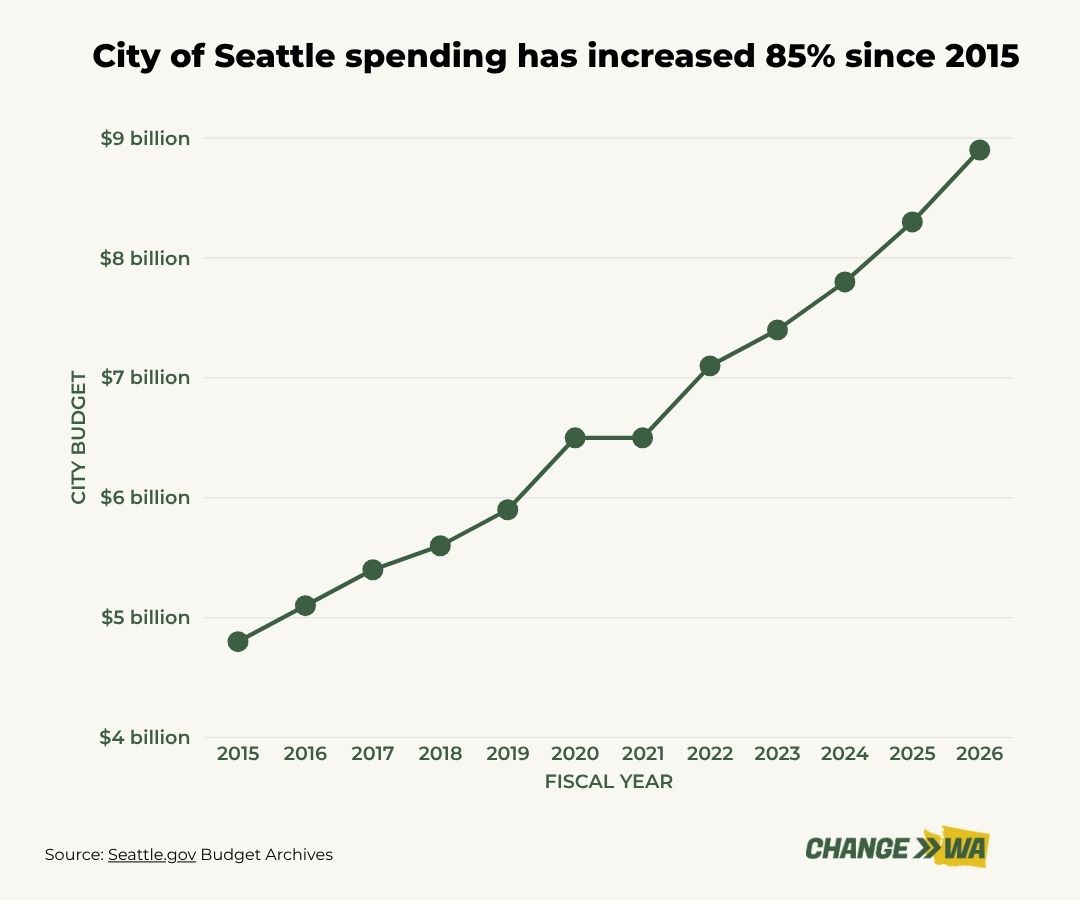
Not only did this cause the city, county, and state governments to vastly increase their budgets, it also created a new controversial bureaucratic entity, the King County Regional Homelessness Authority (KCRHA). Duplicate programs were being approved as tax money poured into local governments to address homelessness issues. This was especially true during the pandemic when the federal government authorized six relief programs totaling $5.5 trillion, which were sent to local governments across the country.
Either on purpose or through poor management, safeguards against wasteful and/or fraudulent spending were not put in place as this money was pouring in and out of King County and the City of Seattle. A 2023 Discovery Institute report found that of the 17 non-profits that had received annual payments of a million dollars or more, only five had submitted required documentation of how many people they had helped in 2021, and only eight filed this paperwork in 2022.
During this influx of money, political leaders failed to properly manage the public funds. In an interview with ChangeWA just before he resigned to become CEO of Sound Transit, Executive Dow Constantine admitted he couldn’t provide an estimate for how much money he had authorized to be spent on the homeless issue for any year since his emergency declaration in 2015.
And while this increase in spending was taking place, homelessness also increased, nearly 70% in King County (from 10,047 in 2015 to 16,868 in 2025). Government officials are already warning that the 2026 figures will be even worse when they are released next month.
This environment of public spending surges and worsening results has caused Councilmember Rivera to call for an audit of the city’s homelessness spending. The recent audit that found the problems in King County have resulted in new procedures to make sure there is more accountability of government spending. If similar problems are occurring within Seattle, then the councilmember wants to correct them to make sure the funds are best spent to help those who are suffering.
The City of Seattle places such a low priority on auditing its activities that it currently employs just five people in its Auditor’s Office. King County, with an annual budget slightly larger than the city’s, currently employs 16 people. To put this into further perspective, Seattle’s Office of Arts & Culture employs 11 times as many employees (55 staff members) as the Auditor’s Office.
The city’s Human Services Department has a budget of $421 million, with $172 million set aside for homelessness programs.
A meaningful audit will reveal whether the city’s homeless programs actually work. A truly compassionate city doesn’t measure its homelessness programs’ success by the money budgeted, but by the number of individuals who have recovered from their difficult circumstances – nearly always caused by addiction and/or mental health issues.
Thus far no other Seattle city councilmember has joined Rivera in her request for an audit. If more councilmembers make the request, then it will become a priority for the auditor’s office. Council President Joy Hollingsworth’s (CD3 – Central Seattle) and Councilmember Alexis Mercerdes Rinck’s (At-Large) support for the audit would be helpful due to Hollingsworth’s leadership position and because Rinck chairs the Human Services, Labor & Economic Development Committee, which oversees the city’s homeless programs.
Please take the time today to contact Councilmember Rivera to tell her you support her request to audit the city’s homelessness services. Also, please contact Councilmember Rinck and ask her to join Rivera’s call for an audit.
- Contact Councilmember Rivera (CD4 – Northeast Seattle)
- Contact Councilmember Hollingsworth (CD3 – Central Seattle)
- Contact Councilmember Rinck (At-Large member)
The era of massive spending and poor results on the homelessness issue is wearing thin with the public who are frustrated by paying higher taxes while seeing the number of homeless encampments increase.