New Seattle mayor stumbles in her first days in office
Within hours of being sworn into office, new Seattle Mayor Katie Wilson instantly stumbled into a major controversary over her administration imposing a significant change to how Seattle police officers handle incidents involving the possession and public use of lethal drugs.
Seattle Police Chief Shon F. Barnes notified his officers of these changes in a memo soon after Wilson’s inauguration on January 2. He wrote, “Effective Immediately, all charges related to drug possession and/or drug use will be diverted from prosecution to the LEAD program.”
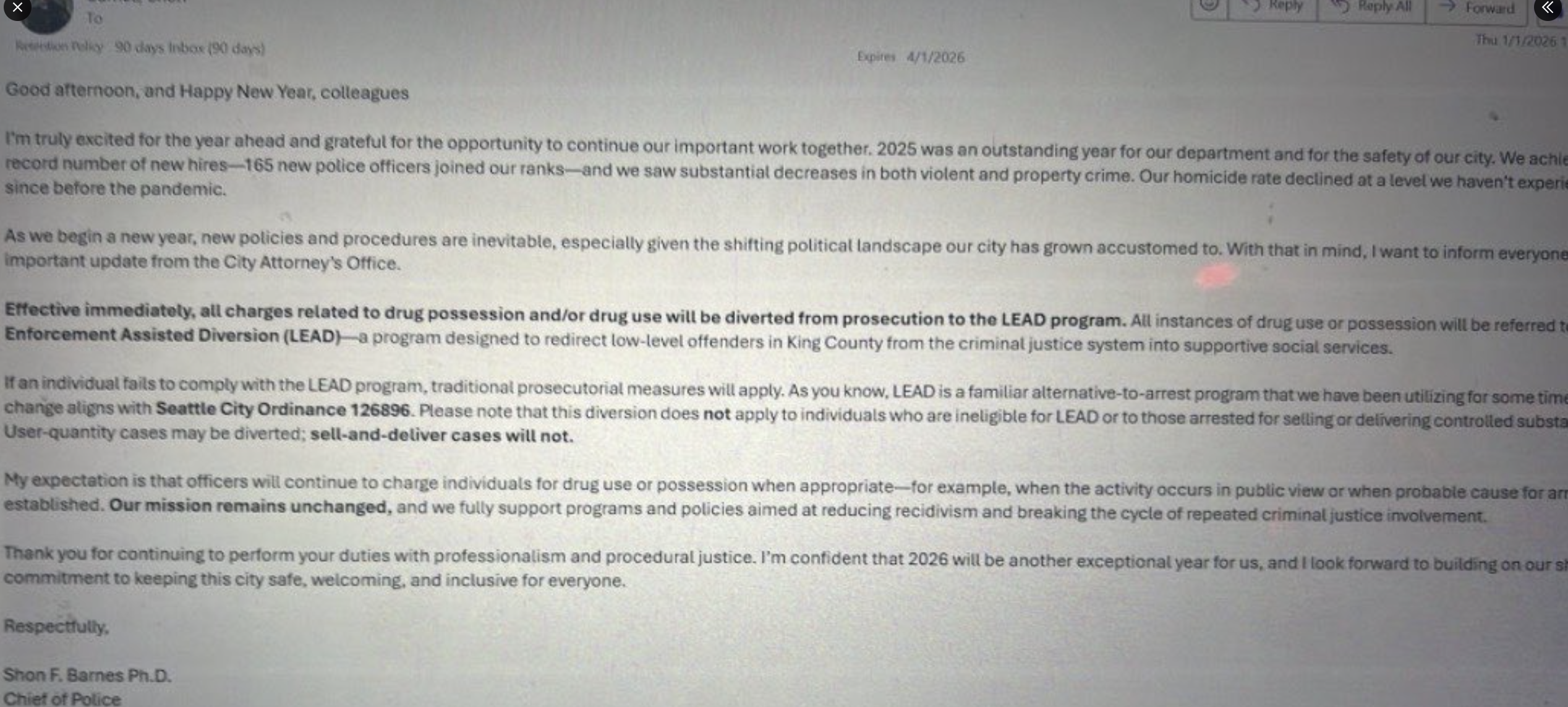
This policy shift removes an important tool police and prosecutors use since the threat of jail time is often necessary to get active addicts to accept treatment. Now, instead of receiving help they desperately need, the suspect is enrolled in the Law Enforcement Assisted Diversion (LEAD) program. Like nearly all diversion programs handled by local governments, LEAD has come under scrutiny for not holding its “clients” accountable and for a high recidivism rate. King County Prosecutor’s Office recently shut down its similar diversion program due to unacceptably high number of participants committing more felonies.
When Chief Barnes’ memo was leaked to the public, it caused an uproar in the local media and on social media as experts and the public expressed concerns that Seattle was returning to the dark days of the pandemic when open drug use was rampant and every year there were a record number of OD deaths in King County with open air drug markets throughout the city.
Seemingly surprised by the uproar her memo to SPD officials caused, the mayor has since backtracked slightly from the policy change. Stating she believes that officers should enforce drug possession and public drug use ordinances, Mayor Wilson contradicted this support of the prosecution process by stating she also wants to “ensure that the LEAD framework…are implanted.” The mayor refused to clarify further and instead stated, “You’ll know when I announce a policy change, because I’ll announce a policy change.”
The mission of the LEAD program is to remove suspects from the criminal system and instead connect them with government services in the belief that these taxpayer-funded programs will lead them to productive lives. King County promotes that it has more than 5,000 services available for those who need assistance.
While a few of these services do provide some help (job training, language skills, money management, etc.) they almost never tackle the underlining causes of the person’s problems – drug/alcohol addiction and mental health issues.
The major dispute over the possible policy change stems from the skepticism police officers have towards the LEAD program. Those who patrol our streets daily do not believe the program is effective and that there is a strong likelihood that the suspect will soon be back on the streets using drugs and committing crimes to fund their addiction.
Seattle Police Officers Guild President Mike Solan put out a public statement asserting that Mayor Wilson’s decision was “naïve” and “ignorant” and that the LEAD program is a “waste of time.”
Solan went on to state that the implementation of this program will result in “death, destruction, and more human suffering.”
MyNorthwest’s Charlie Harger warned that this decision could result in the city returning to 2022 to 2023 when the Washington State Supreme Court’s Blake decision prevented officers from arresting those possessing lethal drugs. Drug overdose deaths skyrocketed in King County/Seattle during this time period with 1,013 deaths in 2022 and 1,340 in 2023 (nearly doubling 2021’s 714 OD deaths). Once drug possession laws were re-established at the end of 2023, OD deaths declined 32.2% to 909 OD deaths in 2025.
Recovery experts expressed their concern that by not prosecuting those who possess and publicly use drugs, we are actually allowing the addict to fall deeper into their addiction. American Addiction Recovery Association Board of Governor Tom Wolf tweeted, “Accountability is a cornerstone of recovery. Seattle has decided not to hold people who use drugs in public accountable. Which means its newly elected mayor isn’t interested in recovery. This will not end well.”
In her new book “The Gabriel Plan,” respected treatment advocate Ginny Burton wrote that for many addicts, incarceration is needed to break the negative cycle that controls their life. Plus being locked up lets them know there are consequences for their illegal actions. Burton writes that when society refuses to either hold criminals accountable and/or remove them from their criminal environment, “we are not protecting their futures, we are guaranteeing their destruction. We are ensuring they become the exact criminals we later prosecute in adult court with long mandatory sentences.”
The LEAD program is like other related “Harm Reduction” drug policies, it is more focused on making individuals dependent on expensive and wasteful government services instead of overcoming addiction issues through total abstinence from drugs. Washington State already has the highest number of chronically homeless individuals (those who refuse any help mostly due to addiction and mental health issues) in the country. With Mayor Wilson promoting open drug use and more social services, homeless individuals will continue to flock to our region.
The Discovery Institute recently surveyed those experiencing homelessness in Seattle/King County. The results clearly show that our region has become a destination location for our county’s homeless population.
- 49.7% experienced homelessness first outside of Seattle/King County.
- 66.8% do not currently or have never had family living in Seattle/King County.
- 86.6 were born outside of Seattle/King County.
Encouraging people who are tax burdens to move into the region while at the same time promoting anti-business policies which cause major taxpayers to move away, is not a good recipe for improving the city’s worsening budget outlook.
During the mayoral campaign, her opponents asserted that Katie Wilson was not prepared for the office. The very clumsy roll out of her drug policies and her s lack of knowledge on how lax drug laws bring more suffering and death, provide evidence that maybe her opponents were correct.
Photo: Screenshot from Center Square Washington.