Seattle is relying on fewer businesses to pay more of its bills. What happens when they leave?
Seattle has increasingly asked its largest employers to pick up more of the bill for city government. For residents who want strong public services and believe successful companies should contribute to the communities where they operate, that may sound perfectly reasonable.
But a new analysis reported by FOX 13 raises a much more practical question: What happens when Seattle becomes dependent on a small group of businesses, and those businesses decide to put their next jobs somewhere else?
Seattle tax collections grew 172% between 2013 and 2025, according to the ECONorthwest analysis prepared for the Downtown Seattle Association and Seattle Metropolitan Chamber of Commerce. During the same period, Seattle’s population grew 31% and employment grew just 23%.
Businesses now provide an estimated 68% of Seattle’s tax revenue, up from about 55% in 2016. And much of that growing burden is concentrated among remarkably few companies.
Fewer than 500 companies pay Seattle’s payroll expense tax, with the 10 largest taxpayers responsible for 73% of the revenue. For the newer social housing tax, just 220 taxpayers reported owing the tax last year, and the 10 largest accounted for 66%.
Together, fewer than 20 distinct businesses are responsible for roughly $356 million in annual city revenue from those two taxes alone.
That is a lot of Seattle’s financial health riding on a very small number of corporate decisions. And those decisions are already changing.
Amazon remains one of Seattle’s most important employers, but its growth in the region has increasingly shifted across Lake Washington. Amazon says Bellevue is where it is “focusing our next phase of growth,” with plans for thousands of workers there. More recently, the company has continued reducing parts of its Seattle office footprint, including leaving a 251,000-square-foot Denny Triangle building this year and reportedly planning to vacate another South Lake Union office when its lease expires.
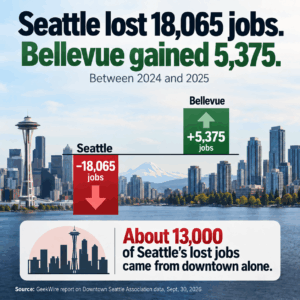
Between 2024 and 2025, Seattle lost more than 18,000 jobs while Bellevue gained more than 5,000. About 13,000 of Seattle’s losses came from downtown alone.
Companies have choices about where their next job will be located, and increasingly they are exercising them.
WaFd, a company headquartered in Seattle for decades, announced last month that its holding company headquarters will move to Bellevue. CEO Brent Beardall said the company has watched Seattle’s struggles and concluded that “Bellevue is where business is gathering.”
Cloud data and artificial intelligence company Snowflake considered expanding in downtown Seattle but instead leased 326,000 square feet in Bellevue. Amazon, TikTok, and other major technology companies have also expanded their Eastside presence.
The competition is not limited to Bellevue.
Starbucks will remain headquartered in Seattle, but the company announced this year that it is investing $100 million in a major new Nashville corporate office expected to eventually employ 2,000 people. Some teams currently based in Seattle are being moved there.
City leaders need to think seriously about whether the current model is sustainable.
Seattle has increasingly built its budget around taxes that generate large amounts of money from an unusually small number of employers. That works very well as long as those companies keep adding highly paid workers inside Seattle city limits.
It becomes much more perilous when those employers shrink, relocate teams, put their next office in Bellevue, or decide their next 2,000 jobs belong in Nashville.
And as companies leave, there’s not exactly a deep bench to replace them. A national analysis by business software company Ringy found that Washington had the lowest five-year business survival rate in the country. Just 41.1% of businesses launched in the state in 2019 were still operating five years later.
And Seattle’s bills do not disappear when the revenue stops growing.
A tax system is only sustainable if the tax base itself remains healthy. When fewer companies are responsible for a growing share of city revenue, every decision to move jobs, shrink office space, or expand somewhere else carries more risk for everyone who depends on city services.
Seattle can continue layering higher costs onto the same businesses and hope they keep growing here, or it can focus more seriously on making the city a place where employers want to add jobs and investment.
If that does not happen, the choices become much harder. The city can reduce spending, reconsider programs that are not delivering results, or look elsewhere for revenue. And if policymakers are unwilling to meaningfully restrain spending, that “elsewhere” increasingly means taxes and fees that reach middle- and lower-income families.
Seattle residents should not have to choose between strong public services and a healthy business climate. A better strategy recognizes that the two depend on each other. Before asking the same shrinking group of employers for even more, City Hall should be asking what it will take to keep those employers, attract new ones, and rebuild the tax base Seattle’s future spending depends on.