Sound Transit’s Accountability Crisis Just Reached a Breaking Point
For many Washington voters, support for public transit has never been the issue.
Over the last three decades, voters repeatedly approved major Sound Transit ballot measures because they believed investing in transit would reduce congestion, connect communities, and help the region grow responsibly. In 1996, 2008, and again in 2016, voters signed off on tens of billions of dollars in taxes and long-term commitments to expand rail service throughout the Puget Sound region.
Now many of those same voters are asking a simple question: What exactly did they get for all that money?
Last week, Sound Transit’s unelected board approved a sweeping revision to its long-promised ST3 expansion plan. The most notable casualty was Ballard, where residents have spent years paying higher sales taxes, property taxes, and vehicle tab fees with the expectation that a light rail line would eventually arrive. Instead, the board voted to fund construction only as far as Seattle Center, leaving the final stretch into Ballard unfunded indefinitely. The stations planned for Smith Cove and Interbay were also cut from the funded project list.
For Ballard residents, the message was difficult to miss: keep paying the taxes, but don’t expect the train you were promised. Recent reporting noted that the revised plan would stop roughly four miles short of Ballard despite the neighborhood being one of the strongest supporters of the original ST3 package.
In 2016, Sound Transit itself estimated ST3 would cost the “typical adult” roughly $200 annually. Over nine years, that’s $1,800, before accounting for higher property values, higher spending, or larger vehicle-tab bills.
Imagine paying into a college fund for ten years only to be told the money is gone and the degree may never happen. Most people would expect an explanation. Many would expect a refund. At a minimum, they would expect accountability.
The Ballard line is not the only project facing major delays.
The South Kirkland-to-Issaquah light rail project is now scheduled for completion in 2050. Other projects throughout the system have been pushed years into the future as Sound Transit struggles to reconcile its promises with its finances. What voters were originally told could be completed by the early 2040s is increasingly being pushed toward the middle of the century.
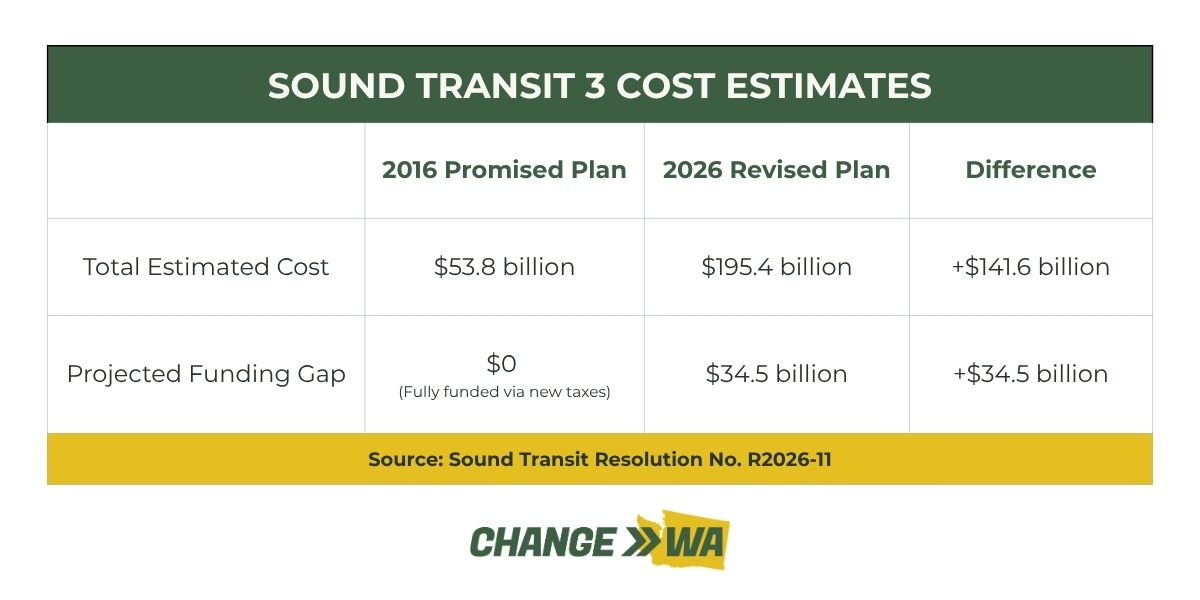
The numbers are staggering. When voters approved Sound Transit 3 (ST3) in 2016, the total estimated cost of the program was $53.8 billion over a 25-year period.
Following the revised system plan approved by the Sound Transit Board on May 28, 2026, the current estimated cost to build out the full, originally promised system has ballooned to approximately $195 billion (with a projected $34.5 billion long-term funding gap over the next 20 years).
Sound Transit says the affordability crisis was caused primarily by construction inflation, increasing property acquisition costs, more complex engineering requirements, higher operating expenses, and lower-than-expected revenues.
But that explanation raises different questions: If these risks were foreseeable, why weren’t they better accounted for when voters approved ST3 in 2016? And if they weren’t foreseeable, why should taxpayers have confidence that future cost estimates will be any more reliable than the last ones? The agency’s own resolution calls for stronger oversight, greater transparency, and improved financial management—an acknowledgment that simply blaming inflation is not enough.
Those questions become even more important when examining the structure of Sound Transit itself.
Unlike a city council or county commission, Sound Transit board members are not directly elected by the people they represent. Instead, they are appointed. For years, Change Washington has highlighted concerns about this governance structure and whether it provides sufficient accountability for an agency responsible for managing one of the largest public infrastructure programs in state history.
Those concerns have only intensified following the appointment of former King County Executive Dow Constantine as Sound Transit’s CEO. As county executive, Constantine played a significant role in appointing members to the Sound Transit board. When the board later selected him as CEO, several members participating in that decision had originally been appointed during his tenure.
Even supporters of transit investment should recognize why that raises concerns. Public confidence depends on transparency and independence. Large public agencies work best when leadership is clearly accountable to the people paying the bills.
The Sound Transit report from last week even directs Constantine to establish an “Independent Oversight Program” that would “identify opportunities to improve cost, schedule, and financial outcomes” for the program – although that should have been in place from the get-go.
Unfortunately, questions about accountability are not new.
Years ago, while serving as King County Executive, Constantine acknowledged in an interview with Change Washington that neither he nor others could fully account for how much money had been spent across the region’s homelessness response efforts. Meanwhile, homelessness continued to worsen despite billions in public expenditures.
Whether discussing homelessness or transit, the underlying issue is the same: voters deserve clear answers about where public money goes and what results it delivers.
This is not an argument against transit. Washington needs reliable transportation infrastructure. Growing communities need mobility options. And taxpayers who supported these investments did so because they wanted the region to succeed.
But public trust is not unlimited.
When projects are delayed by decades, costs continue to rise, and promised stations disappear from the map, voters begin to wonder whether anyone is truly accountable for the decisions being made.
That is why reforming the governance of Sound Transit deserves serious consideration. An agency responsible for collecting billions in taxes and managing projects that affect millions of residents should answer directly to voters. Directly elected board members would not solve every problem overnight, but they would create something currently in short supply: accountability.
At some point, taxpayers deserve more than explanations about inflation, supply chains, or revised projections. They deserve a system where the people making the decisions can be held responsible for the outcomes.
After all, Washington voters have kept their promises to Sound Transit for decades.
The question now is whether Sound Transit intends to keep its promises to them.